Samsung Electronics announced that it has successfully completed what it calls the industry’s first commercial call using its virtualized radio access network (vRAN) solution powered by Intel’s Xeon 6700P-B processor series on a Tier 1 US operator’s live commercial network. The achievement marks a major milestone for network virtualization and builds on Samsung’s 2024 industry-first end-to-end vRAN call conducted in a lab environment using Intel Xeon 6 SoC, according to the official release dated January 13, 2026.
Make Telecom Talk My Trusted Source
Live Network Milestone for vRAN Virtualization
Samsung said it has been pushing the boundaries of network virtualization, offering operators exceptional performance and reliability. “This accomplishment marks a significant milestone, validating that Samsung’s vRAN is the optimal platform for operators to build AI-native, 6G-ready networks by fully leveraging the power of the cutting-edge processor technology,” Samsung said.
The commercial call validates Samsung’s cloud-native vRAN performance under real-world network conditions and demonstrates the feasibility of single-server vRAN deployments for next-generation networks. The trial was conducted on a single commercial off-the-shelf (COTS) server from Hewlett Packard Enterprise, running a cloud platform from Wind River, only months after Intel’s latest Xeon 6 SoC became commercially available.
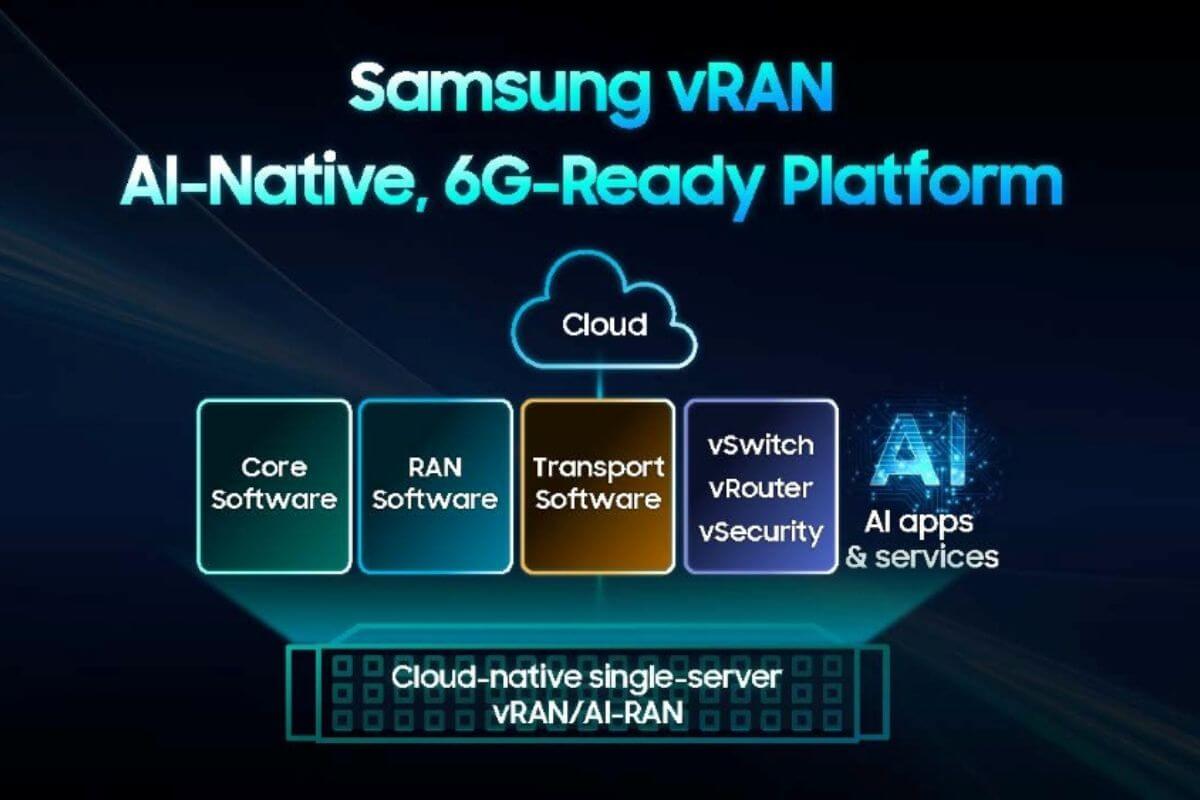
According to Samsung, the milestone highlights how operators can transition toward more software-driven, flexible and sustainable network architectures. By running radio access, core, transport and security functions on a single, more powerful server, operators can significantly simplify network design while reducing power consumption, capital expenditure and operational costs.
Intel Xeon 6 SoC Enables AI-Native Networks
“On a single server of Samsung’s AI-powered vRAN with enhanced processors, operators can consolidate software-driven network elements such as mobile core, radio access, transport and security, which traditionally required multiple servers, significantly simplifying the management of complex site configuration,” Samsung added.
“This innovative approach not only reduces network power consumption, capital expenditure (CAPEX) and operational expenditure (OPEX), but also facilitates operators’ seamless adoption of AI-RAN and AI services, accelerating their readiness for 6G through its flexibility and automation capability.”
“This breakthrough represents a major leap forward in network virtualization and efficiency. It confirms the real-world readiness of this latest technology under live network conditions, demonstrating that single-server vRAN deployments can meet the stringent performance and reliability standards required by leading carriers,” said June Moon, Executive Vice President and Head of R&D for the Networks Business at Samsung Electronics. “We are not only deploying more sustainable, cost-effective networks, but also laying the foundation to fully utilize AI capabilities more easily and prepare for 6G with our end-to-end software-driven network solutions.”
Samsung’s vRAN leverages Intel’s Xeon 6 SoC with up to 72 cores, Intel Advanced Matrix Extensions (AMX) and Intel vRAN Boost, delivering improvements in AI processing performance, memory bandwidth and energy efficiency compared with previous processor generations. The company said these capabilities enable operators to consolidate RAN and AI workloads while supporting future AI-native and 6G-ready network architectures.
Industry Sees Shift Toward Deployable Innovation
“With Intel Xeon 6 SoC, featuring higher core counts and built-in acceleration for AI and vRAN, operators get the compute foundation for AI native, future-ready networks,” said Cristina Rodriguez, Vice President and General Manager of Network and Edge at Intel. “This collaborative achievement with Samsung, HPE and Wind River enables greater consolidation of RAN and AI workloads, lowering power and total cost while speeding innovation.”
Industry analysts said the announcement signals a shift from theoretical performance gains toward deployable network innovation. “This successful first call is an important milestone for the industry,” said Daryl Schoolar, Analyst and Director at Recon Analytics. “By demonstrating multiple network functions running on next-generation processing technology, Samsung is showing what future networks look like — more cloud-native, more scalable and significantly more efficient.”
Samsung has been a key proponent of vRAN and Open RAN deployments globally and has worked closely with ecosystem partners to advance cloud-native mobile network architectures. The company said it will continue expanding its portfolio across purpose-built RAN, vRAN, Open RAN, AI-RAN and core solutions as it supports operators in modernizing 5G networks and preparing for 6G and beyond.
 Support Telecomtalk