Also Read: Jio Rs 349 Prepaid vs Postpaid: 56GB vs 30GB Clearly Shows Which Plan Offers More Data Value
3. Jio Postpaid Rs 349 Plan
Pack Type: Individual Plan, Postpaid Plan
Core Benefits: Unlimited Voice, 100 SMS/Day, 30GB Data, there after Rs 10/GB. Unlimited 5G data for eligible subscribers.
Validity: Bill Cycle
Subscriptions and Benefits: JioTV, Jio Special Offer benefits, JioHotstar: Mobile subscription 3 months, JioAICloud: Free 50 GB storage. Free 18-month Pro Plan of Google Gemini worth Rs 35,100, with 5000 GB cloud storage, Nano Banana and more.
Effective Per Day Pricing: Rs 11.63
4. Vi Max 451 Plan
Pack Type: Individual Plan, Postpaid Plan
Core Benefits: Unlimited calls (Local, STD, National Roaming), 50 GB data with up to 200 GB rollover in select circles or Limitless Data in select circles (300 GB in a month is defined as the maximum data as per the commercial usage policy, post which speeds reduce to 64 Kbps), and 3000 SMS/month. Includes unlimited 5G data in 5G coverage areas and Night Binge (unlimited data usage from 12 AM to 6 AM). PayGo data charges at Rs 20/GB.
Validity: Bill Cycle
Subscriptions and Benefits:
Choice of any 1 complimentary benefit: Vi Movies and TV (ZEE5, SonyLIV, JioHotstar, and more — first 3 months free) or JioHotstar (1-year mobile subscription), Sony LIV (360-day mobile subscription), or Norton (1-year Mobile Security cover).
Additional Benefits: Vi Games (Esports, Multiplayer games and more for free on Vi App).
Effective Per Day Pricing: Rs 15.03
Consumer Price Index Report by Ministry of Statistics and Programme Implementation
“The price for both prepaid and post-paid services offered by the four major telecom operators, viz. BSNL, Jio, Vi and Airtel were collected. While telecom plans vary across parameters such as validity, voice, data and SMS, it was observed during discussions with Telecom Regulatory Authority of India (TRAI) that most plans currently offer unlimited voice calls and standardized SMS (100 messages), with only marginal variations in data volumes. Further, telecom tariffs are largely uniform across telecom circles, particularly for Jio and Airtel, with only minor circle-level variations observed for Vi and BSNL,” the Consumer Price Index Report released in January 2026 by the Government of India said.
Market Reports
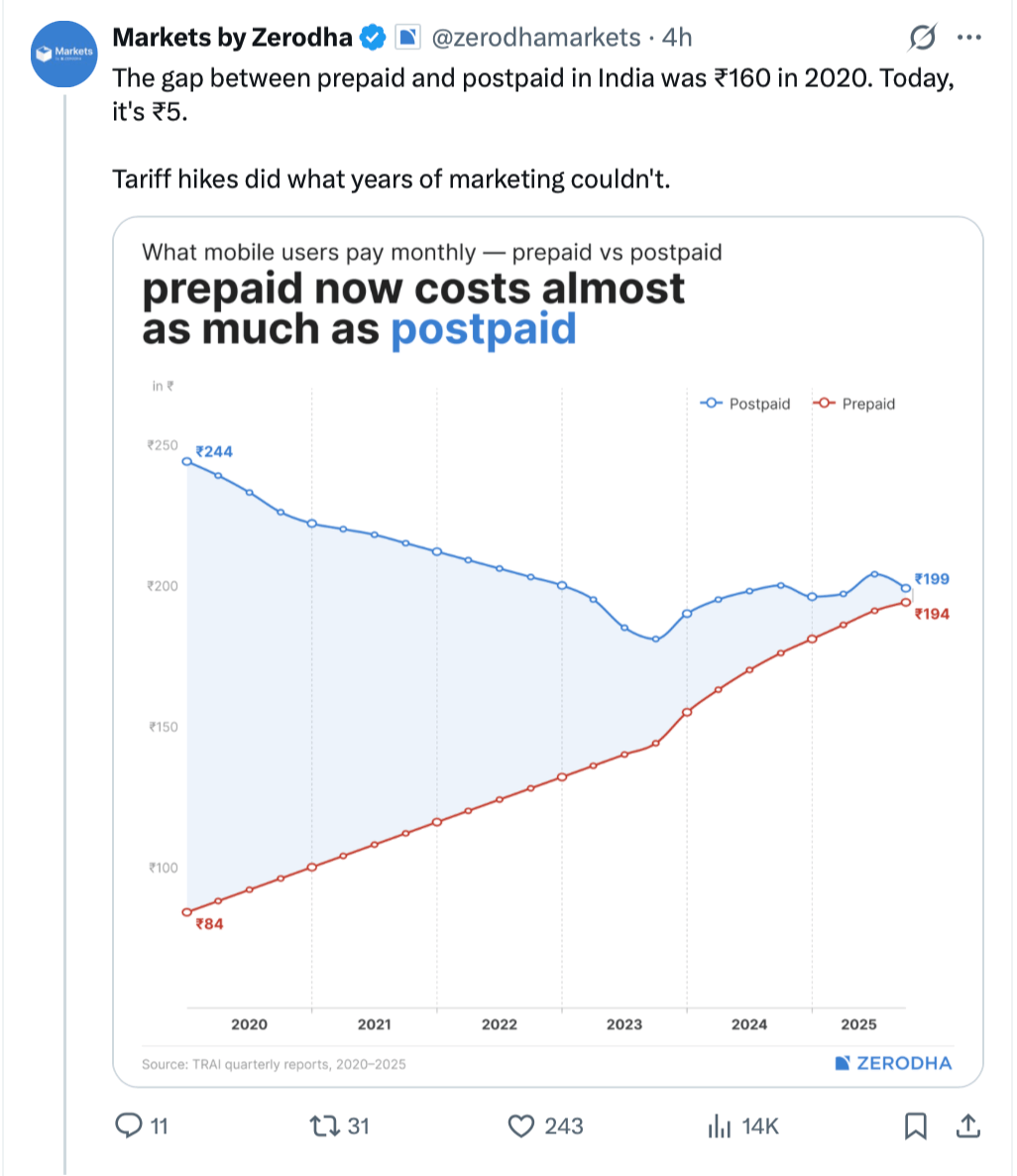
Meanwhile, Markets by Zerodha, on its social platform X, shared an infographic on May 11, 2026, stating:”The gap between prepaid and postpaid in India was Rs 160 in 2020. Today, it’s Rs 5. Tariff hikes did what years of marketing couldn’t.”

For the first time since India’s mobile revolution began, the gap between prepaid and postpaid average revenue per user (ARPU) has nearly disappeared, as the country’s mass-market prepaid users now spend on par with premium postpaid subscribers, according to government data from 2025, The Hindu BusinessLine reported on May 2, 2026.
The ARPU gap, which used to be as wide as Rs 129, with prepaid at Rs 84 and postpaid at Rs 244 in 2020, is now nearly the same at around Rs 194 for prepaid and Rs 199 for postpaid in the quarter ending December 2025. The levelling signals a shift in the telecom market that could reshape postpaid pricing, premium positioning, and subscriber acquisition strategies.
TV Ramachandran, President at Broadband India Forum (BIF), was quoted as saying in the report that the trend may, in fact, encourage some amount of migration from prepaid to postpaid to avoid the hassle of repeated recharges.
“Postpaid is fixed always. If the prepaid advantage of lower prices is not there now, they may switch to postpaid. However, the trend is unlikely to sustain for long. Postpaid customers don’t mind paying a little more,” said Ramachandran, according to the report.
Analysing the trend, Mahesh Uppal, Director of Com First (India), was quoted as saying that prepaid and postpaid customers have different motivations for opting for a plan. Postpaid helps avoid regular recharges, while prepaid ensures transparency and budgeting.
When asked whether prepaid users should enjoy the same additional benefits as postpaid users, Uppal reportedly said the features of the two plans are very different, with distinct advantages. Even with the same ARPU numbers, the TRAI data does not show granular usage on how prepaid subscribers consume their packages.
“Prepaid does get its share of benefits in a different place. There are no major benefits that postpaid users get over prepaid users, other than avoiding disconnections if they miss a payment. They have some amount of debt they can accrue. Prepaid user has the option of delivering variable revenues to the operator,” he reportedly said.
Note: Telcos may also offer select plans in specific circles such as Jammu and Kashmir or Himachal Pradesh, as well as new acquisition plans available in stores or offline channels. These are not included in the story, as only openly available plans across major circles have been listed.
Conclusion
You can pick the operator based on your circle, network experience, and the data usage you get in a billing cycle. You also need to add GST to arrive at the total price you will end up paying. So, based on 4G or 5G availability, you can opt for a plan according to your spending capacity. Unfortunately, there are not many options for users requiring voice-only usage. Maybe telcos are also under the impression that everyone needs data usage these days, and so are the offerings.
Some people read for free. A few choose to support. If you found TelecomTalk useful, you can help keep us running.
 Support Telecomtalk