The Supreme Court of India on Friday ruled that telecom service providers cannot use the moratorium under the Insolvency and Bankruptcy Code, 2016 (IBC) to restructure or defer payment of licence fees and spectrum dues payable to the Department of Telecommunications (DoT) by treating spectrum as a corporate asset. The ruling came in Union of India vs State Bank of India.
Make Telecom Talk My Trusted Source
Spectrum is a community resource, says Bench
A Bench of Justices P.S. Narasimha and Atul Chandurkar held that spectrum is a material resource of the community and must be managed in a manner that subserves the common good. “We hold that Spectrum allocated to TSPs and shown in their books of account as an asset cannot be subjected to proceedings under the Insolvency and Bankruptcy Code, 2016,” the Court said.
The ruling came in a dispute arising from the insolvency of Aircel Limited, Aircel Cellular Limited and Dishnet Wireless Limited, which had entered the corporate insolvency resolution process after defaulting on licence fee and spectrum usage charges.
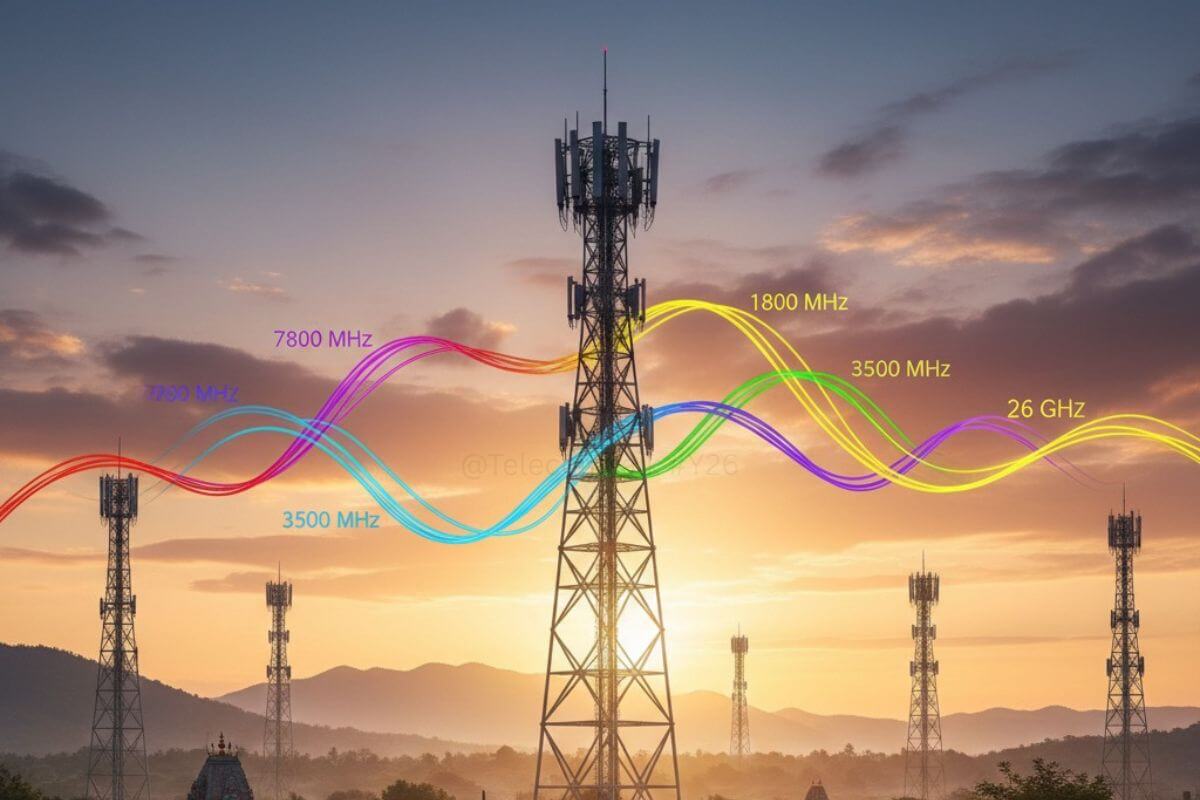
The Aircel group had been granted Unified Access Service Licences on December 5, 2006 for a 20-year term. It subsequently acquired spectrum in the 900 MHz, 1800 MHz and 2100 MHz bands through auctions held between 2010 and 2016, paying over Rs 6,249 crore. A consortium led by State Bank of India extended term loans aggregating Rs 13,729 crore under a 2014 financing arrangement.
Following financial stress, the companies filed voluntary petitions under Section 10 of the IBC in 2018. The National Company Law Tribunal admitted the pleas, and the Department of Telecommunications lodged claims of approximately Rs 9,894 crore towards unpaid licence and spectrum dues.
NCLAT view on spectrum as intangible asset
A resolution plan submitted by UV Asset Reconstruction Company and approved by the committee of creditors was later challenged by the Union government before the National Company Law Appellate Tribunal. The appellate tribunal had held that while spectrum remains a natural resource owned by the nation, the licensee’s right to use it constitutes an intangible asset and can be dealt with in insolvency, though not without clearing government dues.
Re-examining the issue, the Supreme Court framed the central question as whether insolvency law could be invoked to alter ownership or control over spectrum or dilute statutory obligations attached to its use.
Answering in the negative, the Bench relied on Article 39(b) of the Constitution, which requires material resources of the community to be distributed to subserve the common good and not be treated as private commercial assets divorced from public interest. It said the right to use spectrum flows from a licence granted under a special statutory regime and does not confer proprietary rights on the holder. The court described spectrum as a “material resource of the community.”
Government a trustee, not a transferor
The Court held that the IBC cannot be the guiding framework for restructuring ownership and control of spectrum. Entry into insolvency, it said, does not convert spectrum into a freely transferable commodity, nor can the moratorium be relied upon to escape or postpone payment of licence-related liabilities.
Calling for a harmonious interpretation of the IBC and the telecom framework, the Bench observed that the Government holds spectrum as trustee for the people, and that its control cannot be diluted through insolvency proceedings.
“TSPs have the right to use spectrum under licence granted to them. They cannot be said to be the owners in possession of the spectrum but only in occupation of the right to use spectrum. Ownership of spectrum belongs to Nation (people) with Government only being its Trustee. Possession correlates with the ownership right,” the Supreme Court judgement read.
Every article you read here is the result of time, research, and effort. If you feel it adds value, you can support TelecomTalk.
 Support Telecomtalk