Shopping for an AI chatbot platform in 2026 feels less like choosing software and more like wading through a trade show. Every vendor promises “human-like” conversations, “no-code” setup, and “enterprise-grade” everything. The hard part is not finding options — it is telling them apart.
This is a buyer’s framework built to cut through that noise. It will not name a single winner, because the right platform genuinely depends on your channels, your team, and your budget. Instead, it gives you a repeatable way to score the field.
The conversational AI market has moved from emerging to mainstream. Grand View Research estimates the global conversational AI market in the tens of billions of dollars and growing at a double-digit annual rate through the end of the decade. A growing market is good news for buyers — it means real competition, faster feature cycles, and downward pressure on price — but it also means a flood of near-identical landing pages.
The capability frontier is shifting too. Gartner projects that agentic AI will autonomously resolve a large majority of common customer-service issues by 2029. That matters for a buying decision today: a platform that can only answer questions may look cheaper now and feel obsolete in eighteen months. When you evaluate, ask not just “what can it answer?” but “what can it do — and how will that expand?”
The six-dimension scoring framework
Resist the urge to compare feature checklists line by line. Instead, score each candidate platform from 1 to 5 on six dimensions, then weight those scores to your own context.
1. Channel coverage
Where do your customers actually message you — your website, WhatsApp, Instagram, Messenger, SMS? A platform that is brilliant on the web but weak on WhatsApp is the wrong tool if half your audience lives in WhatsApp. Map your channels first, then check real coverage, not just logos on a marketing page.
2. Build experience and maintainability
“No-code” is a spectrum. Some builders are genuinely usable by a non-technical owner; others are no-code in name and require a specialist to maintain. The question is not how impressive the demo looks but how easily you will update a flow six months from now when a policy changes.
3. Integration depth
A chatbot that cannot see your order data, CRM, or help-desk is a glorified FAQ page. Check whether the integrations you need are native, available through a connector, or require custom development. This is where projects quietly stall.
4. AI quality and control
Modern platforms differ enormously in how their AI behaves. Can you ground it in your own knowledge base? Can you constrain it to prevent confident-but-wrong answers? Can you bring your own model? For any business where a wrong answer has consequences, controllability matters as much as raw fluency.
5. Analytics and escalation
You cannot improve what you cannot see. The platform should report containment, escalation reasons, and satisfaction — and hand off to a human with full context when needed. Weak analytics is a silent tax you pay every month you cannot find your content gaps.
6. Total cost, honestly calculated
The subscription is the visible price. The real price includes message-volume or per-resolution fees, integration work, and the cost of switching later. Model the cost at your expected volume, not the starter tier.
Turning scores into a decision
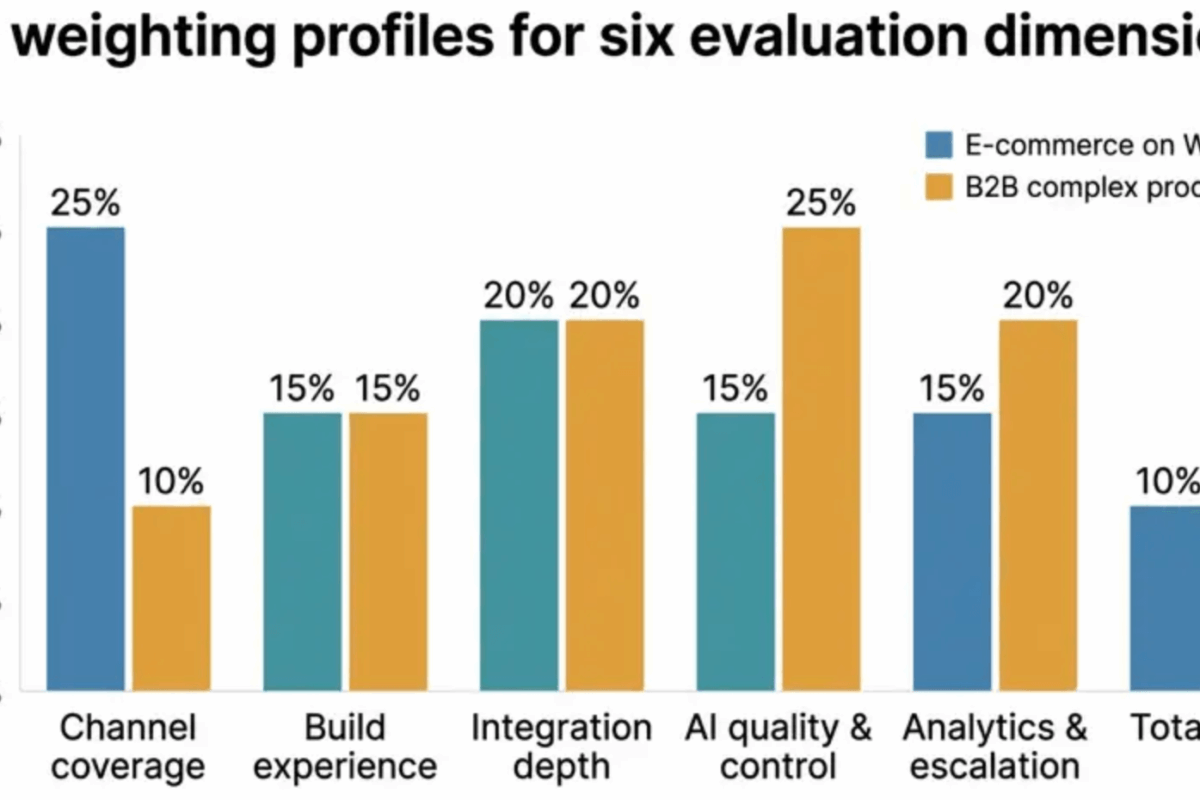
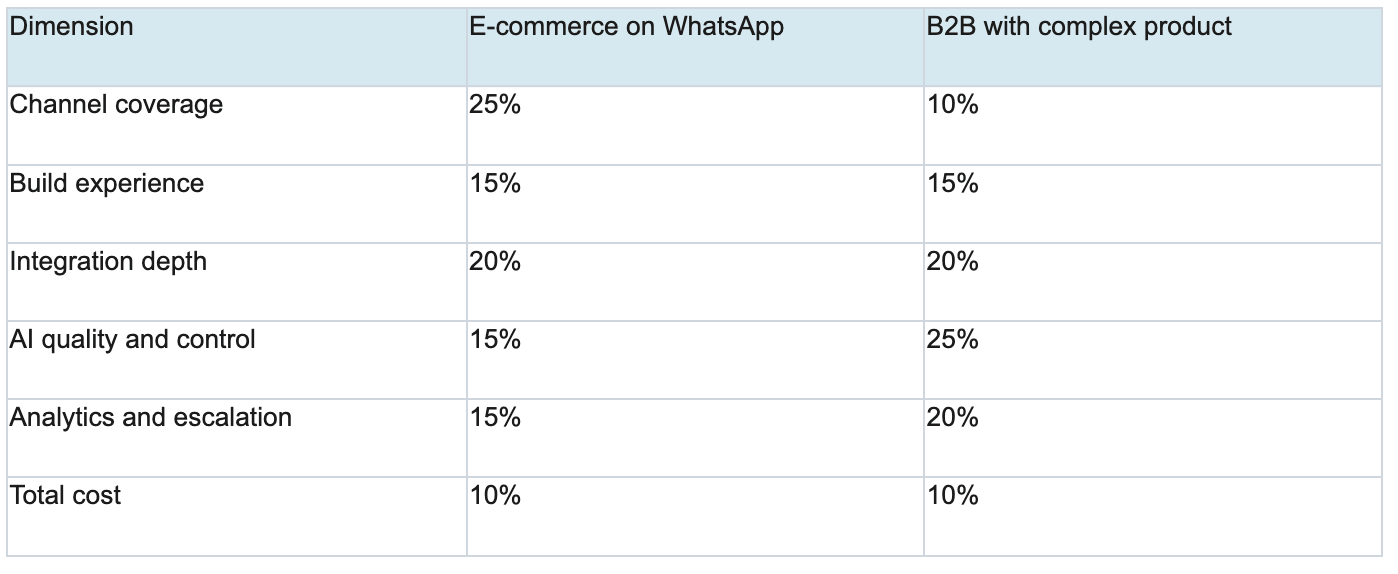
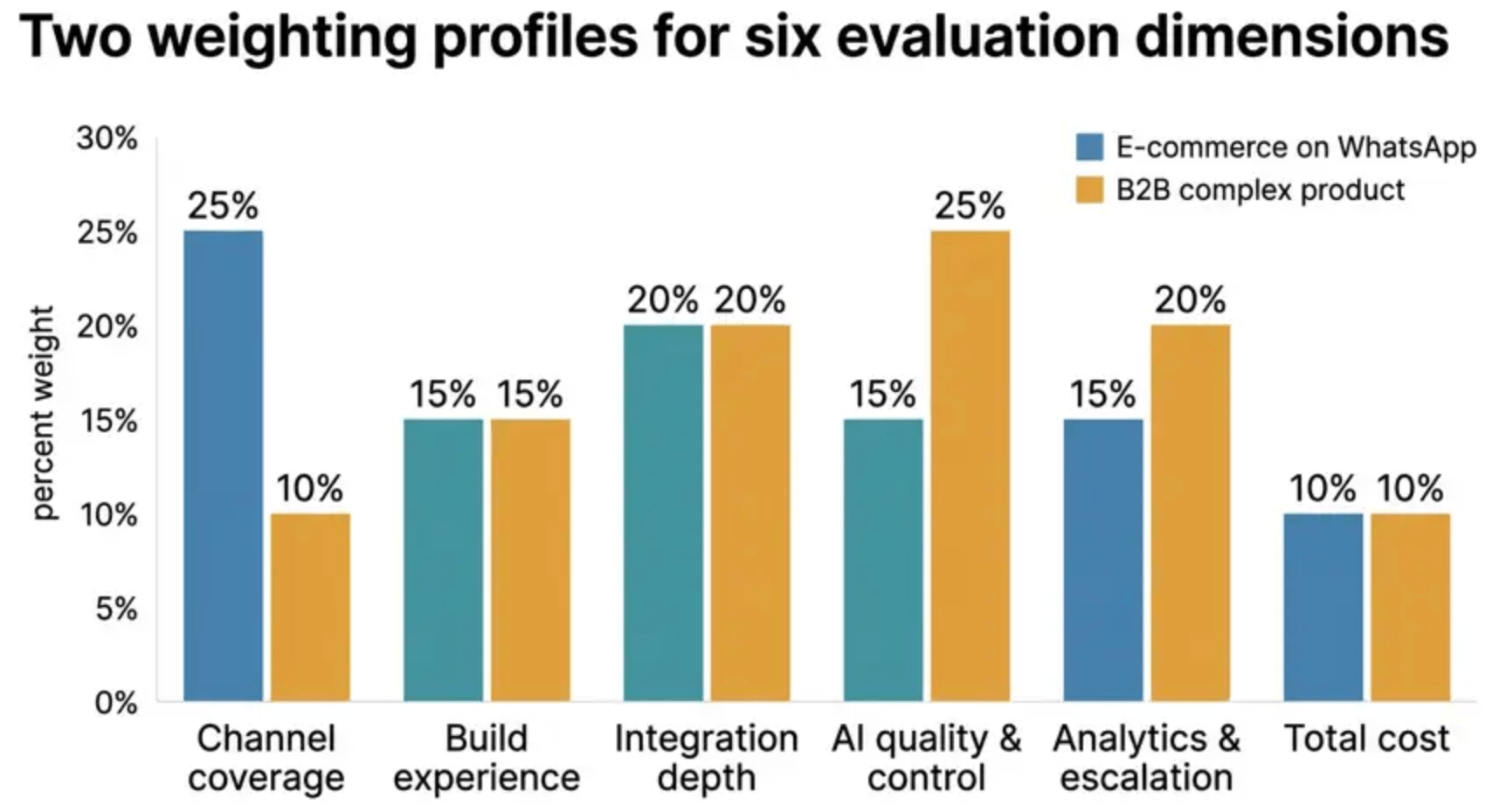
Once you have scored each platform 1–5 on all six dimensions, apply weights that reflect your reality. A high-volume e-commerce store on WhatsApp weights channel coverage and integration heavily. A small B2B firm with a complex product weights AI control and analytics. The table below shows two illustrative weighting profiles.


Figure 2: The same six dimensions, weighted to two different realities. Your weights should reflect your channels and stakes.
Multiply each platform’s score by your weights, sum the results, and you have a defensible ranking — one you can explain to a partner or a boss without hand-waving.
Avoiding the three most common buying mistakes
Buying for the demo, not the daily. Demos are built to dazzle. Ask the vendor to show you the screen you will use weekly — the flow editor, the analytics dashboard, the escalation queue.
Underestimating volume pricing. Many platforms price on conversations, resolutions, or messages. A plan that is cheap at 500 conversations a month can be punishing at 5,000. Always model your growth case.
Signing annual before piloting. The single best protection against a bad choice is a short, scoped pilot on your real customer questions. Two weeks of genuine traffic reveals more than any sales call.
Where independent comparisons help
Vendor sites are designed to make every platform look like the obvious choice. The antidote is independent, side-by-side analysis that tests the same dimensions across competitors and is transparent about methodology. For a category-by-category starting point, curated breakdowns such as the best AI chatbot platforms roundup are a faster way to build a shortlist than opening fifteen vendor tabs.
Use those comparisons to narrow the field to two or three candidates — then run your own pilot. No third party can tell you how a platform feels on your questions with your customers.
Frequently asked questions
Is the most expensive platform the best?
No. Price correlates loosely with capability and not at all with fit. A high-end enterprise platform is often the wrong tool for a small team that will use a fraction of its features.
Should I prioritize a no-code builder?
Prioritize maintainability for your team. If no one on your side can code, a genuinely no-code builder matters. If you have a developer, integration depth may matter more than the builder’s polish.
How important is “bring your own model”?
It matters most when you need control over AI behavior, cost, or data handling. For a simple FAQ bot it is a nice-to-have; for a regulated or high-stakes use case it can be decisive.
How long should a pilot run?
About two weeks of real customer traffic. Long enough to surface recurring questions and edge cases, short enough that you are not stuck if the platform disappoints.
The takeaway
There is no universal best chatbot platform — there is only the best fit for your channels, your team, and your budget. Score candidates on six dimensions, weight them to your reality, model the true cost at your real volume, and pilot before you commit. Do that, and you will choose with evidence instead of vibes.
A small group of TelecomTalk readers helps keep this platform running. Support us if you find our work valuable.
 Support Telecomtalk