Qualcomm and Google Collaborate to Enhance Project Treble and Provide 4 Years of OS Updates

Most readers read for free. A small group from the TelecomTalk community keeps this going. Support only if our work adds value for you.

Follow Us

Chipmaker Qualcomm and Google today announced their collaboration to enhance and extend Project Treble to offer four years of software updates. This partnership was established to enable more devices with Qualcomm Snapdragon Mobile Platforms to run the latest Android OS. Qualcomm says the enhancements are intended to enable Original Equipment Manufacturers (OEMs) to upgrade their Snapdragon-based devices to the latest Android OS without modifying Qualcomm's chipset-specific software and to use a common Android software branch to upgrade devices based on a wide range of Snapdragon mobile platforms across the company's portfolio.


Future Android Phones to Get 4 Years of Android Updates

The enhancements which are being made to Project Treble will reduce the time and resources required to upgrade Snapdragon-based devices to the latest Android OS version. The best part is both Google and Qualcomm are promising four years of Android OS versions along with four years of security updates for all Snapdragon platforms utilising the new Project Treble enhancements. The latest Snapdragon 888 5G Mobile Platform will be the first chip to get enhanced Project Treble.

“Google continues to work closely with our technology partners to increase the freshness of the Android ecosystem. Through this collaboration with Qualcomm Technologies, we expect that Android users will have the latest OS upgrades and greater security on their devices,” said David Burke, vice president of Android engineering, Google.

Project Treble: What Exactly Is It?

Project Treble created a split between the OS framework and device-specific low-level software called the vendor implementation through a properly defined and stable vendor interface. Thanks to this split, the Android OS framework guarantees backward compatibility with the vendor implementation. With every new Android release, Project Treble publishes the Generic System Images (GSIs) that are built from AOSP sources, and are guaranteed to be backwards-compatible with the previous three versions of vendor implementations.
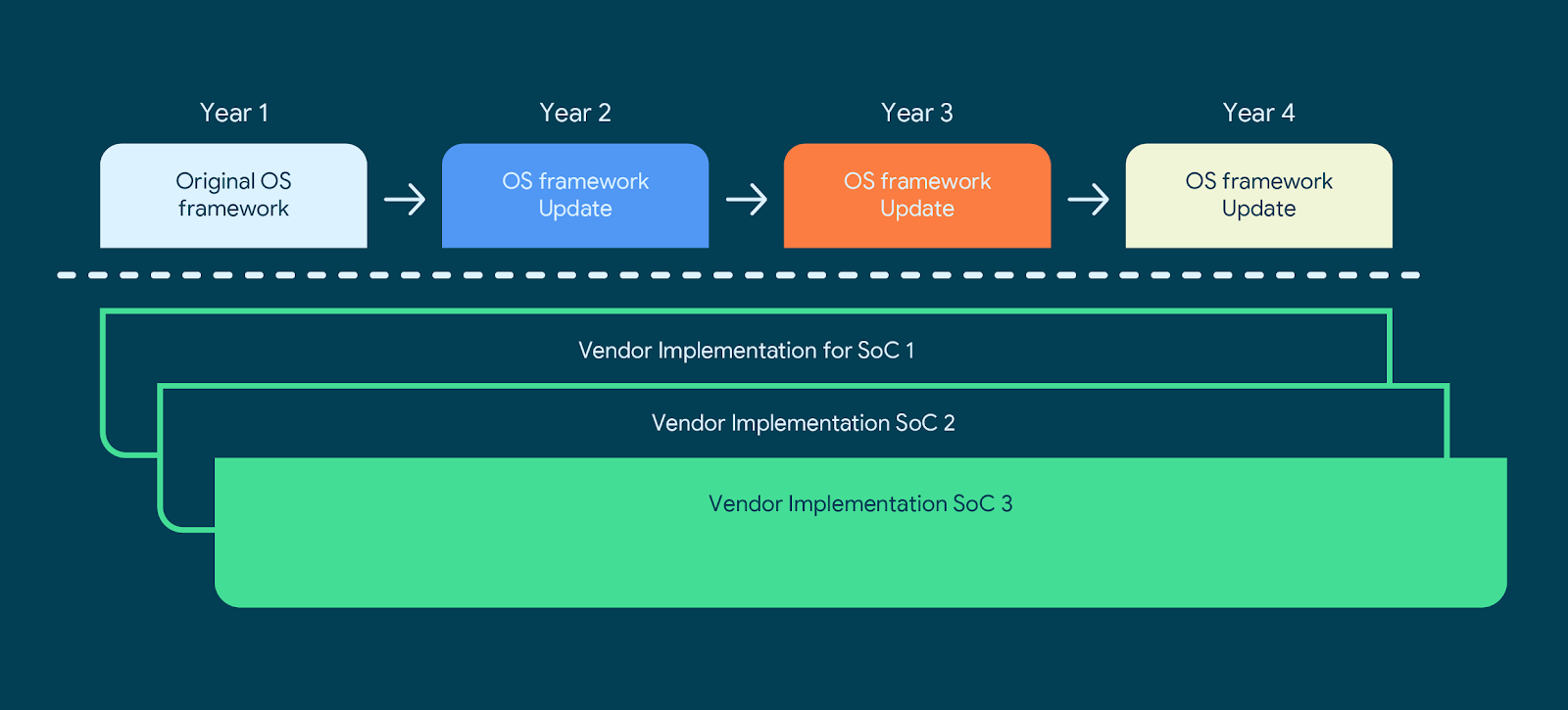

Therefore, devices launching with the new Android release must have vendor implementations compatible with that particular GSI. "This is the primary vehicle for reducing fragmentation within the OS framework," says Google. Besides the reuse of a vendor implementation across OS updates, the Treble architecture also facilitates the re-use of the same OS framework code across different vendor implementations.

Having said that, Project Treble had its complexities for System-on-Chip manufacturers. For each SoC model, the SoC manufacturers are required to create multiple combinations of vendor implementations to support OEMs who would use that chipset to launch new devices and deploy OS upgrades on previously launched devices. This essentially meant that three years after the launch of an SoC, the vendor would have to support up to six combinations of OS framework software and vendor implementations.

Google realised that the problem was not with the device requirements instead it is with SoCs. So it created a new solution: Google extended the no-retroactivity principle to the SoCs as well as to devices. With this change, the SoC provider would be able to support Android with the same vendor implementations on their SoCs for device launches as well as upgrades.

Going forward, Google will reuse the same OS framework software across multiple Qualcomm chipsets. This lowers the number of OS framework and vendor implementation combinations that Qualcomm has to support across their mobile platforms and results in lowered engineering, development, and deployment costs.

Google confirmed the change would take effect with all SoCs launching with Android 11 and later.

Most readers read for free. A small group from the TelecomTalk community keeps this going. Support only if our work adds value for you.

Reported By

Managing Editor

Chakri is a go-to guy for your next smartphone recommendation. Back in his engineering days, he used to play with smartphones by installing custom ROMs and that passion got him into the tech industry. He still goes nuts about a smartphone knocking his door for review. Currently managing everything at Telecom Talk, Chakri is trying to master PUBG Mobile in his free time.

Recent Comments

Faraz :

When BSNL coverage with 700Mhz+2100Mhz will go past 3L sites then it will be something to talk about, as of…

Bharti Airtel Adds Over 5 Million Wireless Subscribers in March…

Gareeb Hu Bhai :

Fir se scam 203 crore ka research ke naam pe. Anpad log aur engineers bitha denge woh copied maal inko…

Scindia Launches Revised TDIP Scheme With Rs 203-Crore Outlay to…

Faraz :

I ported in Vi as it works at my office and at home I got Wi-Fi. Experience is not as…

Bharti Airtel Adds Over 5 Million Wireless Subscribers in March…

Gareeb Hu Bhai :

Maybe in his area Jio becomes crap like at mine. So I said goodbye to it. I recharged Vi today.…

Bharti Airtel Adds Over 5 Million Wireless Subscribers in March…

TheAndroidFreak :

What happened to Jio? Vi does have 300GB cap on 4G/5G cap. Depending on what you use.

Bharti Airtel Adds Over 5 Million Wireless Subscribers in March…

Load More
Subscribe
Notify of
guest
4 Comments
newest
oldest most voted
Inline Feedbacks
View all comments