


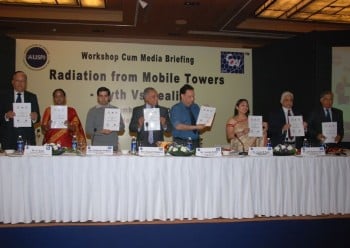
The first of its kind study, specific to the Indian environment carried out independently by the Premier Engineering Institutes revealed that “Levels of Radiation” from cellular/Mobile base stations BTS) in Delhi fall hundreds of times below international safety standards.
The independent study was commissioned by the Cellular Operators Association of India (COAI) and Association of Unified Telecom Service Providers of India (AUSPI) as a proactive measure stemming from the concern for the public health and safety issues.
Leading experts from the Indian Institute of Technology Madras, Chennai (IITM), Thiagarajar College of Engineering, Madurai (TCE) and Centre of Excellence in Wireless Technology, Chennai (CEWIT), while carrying out measurements on the electromagnetic radiation at over 180 locations in New Delhi found that in all circumstances, the “Cumulative Measurements” were well below the compliance limit set by the International Commission on Non-Ionizing Radiation Protection (ICNIRP), adopted by the Government for the Telecom sector in India, bringing it at par with the International safety standards.
While adopting international standards on public health and safety in 2008, companies in India must by law adhere to prescribed limits for Base Station Antennae for general public exposure.
The study measured cumulative emissions within the 800 to 2000MHZ band of frequency (which includes both GSM and CDMA technologies) across in the nation’s capital using carefully calibrated equipment, as per the Dot prescribed procedure in line with the ICNIRP specifications.. The basic restrictions/proper limits for power density specified in ICNIRP guidelines for safe frequencies between 400 to 2000 MHz are as follows:
| Type of Exposure | 900MHz(inW/m2) | 1800MHz (in W/m2) |
| Occupational | 22.5 | 45 |
| General Public | 4.5 | 9 |
Prof. P.R.Goundan, Joint Director Centre of Excellence in Wireless Technology, Chennai, stated that “It is one of the first studies carried out in the Indian environment to assess the level of emissions from the Mobile Towers. We are happy to note that the cumulative emissions are much below the prescribed limits and that the service providers in India are complying with the safety norms.
Prof. Dr.S.Raju, Head of Department ECE Thiagarajar College of Engineering, Madurai a leading scientist , awarded recently by the Tamilnadu State Government further stated that “ Any hazard to the public health is a larger societal concern. It is important that statements concerning public and health & safety should be well supported with facts and scientific evidence. The study brings out very clearly that even in the worst case scenario the cumulative emission levels were far below the INCNIRP standards.”
The study was commissioned in tandem by COAI and AUSPI, whose related aims include sustaining a world-class cellular infrastructure in India, the new finding come as a response to growing public concern over myths associated with the emissions from the cellular mobile towers and its alleged health effects on the human body.


Vipul September 10, 2012 at 12:42 pm
it is amazing that studies from both sides try to convince us that either radiations from these towers are safe or are harmful but for common man it is very confusing to whom to believe or it has become a choice of convinience. we need mobile and the present tech available both in India and abroad relies on these towers. if this tech is harmful to such level I believe that the euro/us countries would have found the suitable replacement tech rather than putting their people in hazardous zone. however i am ready to change my beliefs.
we are all heavily dependent on the mobile phn/apps and become restless as soon as we are out of coverage and the first question which we ask is where is the network available. hopefully our govt. can put these fears to seize from the minds of the people at the earliest or those opposing this tech should provide a tech for replacement of the same before creating suspicion in minds.
sunil noronha December 28, 2010 at 9:14 pm
ha ha ha.
this is india mate.
everything is available for a price.
n who sponsored the study?
Ahamed December 24, 2010 at 5:51 pm
A study of the private for the private by the private?
Sam From Kashmir December 22, 2010 at 9:12 pm
CM revokes ban on SMS in J&K on Wednesday, December 22, 2010 at 8:42pm
JAMMU, DECEMBER 22 – Chief Minister, Mr. Omar Abdullah has ordered revocation of ban on the SMS services in Jammu & Kashmir on post paid connections.
In a high level meeting chaired by the Chief Minister here today a decision was taken to revoke the ban on the SMS services in Jammu and Kashmir on all post paid connections after reviewing the overall security situation in the State. However, the ban on post paid bulk messages will continue.
The BSNL and the telecom companies operating in the State of Jammu & Kashmir have been advised to start the service as soon as possible.
The meeting among others was attended by the Director General of Police, Mr. Kuldeep Khoda and Principal Secretary to Government, Home Department, Mr. B. R. Sharma.
sud December 22, 2010 at 10:19 am
Sab paiso ka khel hain …..
Raccoon December 22, 2010 at 12:55 am
The fact that this study is chock full of holes is so apparent. But what is more amazing is that it seems to be selling. Almost every one here is buying… sigh!
sam December 22, 2010 at 12:20 am
i didnt expect a study funded by Cellular Operators Association of India (COAI) and Association of Unified Telecom Service Providers of India (AUSPI) to come out with results that are not favourable to them.
but the other day i saw a news program showing video of the measuring device and it clearly showed the tower radiation levels were shockingly high. check the link for more details. http://ibnlive.in.com/videos/137248/mobile-tower-radiation-a-major-health-hazard.html
Geffry December 21, 2010 at 9:39 pm
Interesting study, thanks for sharing!
PD December 21, 2010 at 8:20 pm
We have no options and have to live with it ! This is the price we have to pay for changing lifestyles.
Abhi December 21, 2010 at 7:20 pm
Its pleasing to know our service providers are abiding by the regulation prescribed by Govt. But I think this can be further reduced by controlling the number of operators per circle. If COAI, Telecom ministry & Health ministry come together to restrict number of 2G licences in every circle like in 3G, then the radiation would be even lesser. To help us, the consumers, Govt should monitor the service charges also. Because, to me, if any step is taken to restrict operators, then competetion will be less and consequently prices go up
However, its my view only. What do u think friends? Is it really necessary to have some 10 operators per circle to increase tele-density to flourish in technoslogy? Take for example USA.


som December 21, 2010 at 6:35 pm
hopefully now all these bad media will stop and they will not be harassed for establishing new towers.
ishams December 21, 2010 at 6:25 pm
is it a study based by the BTS in delhi only? or for all over india?.
upen December 21, 2010 at 5:59 pm
Thank God ! Our service providers are at least concerned about public health and safety. (but not much concerned about public money) !
kanna December 21, 2010 at 5:46 pm
good going Indian Telecom!